
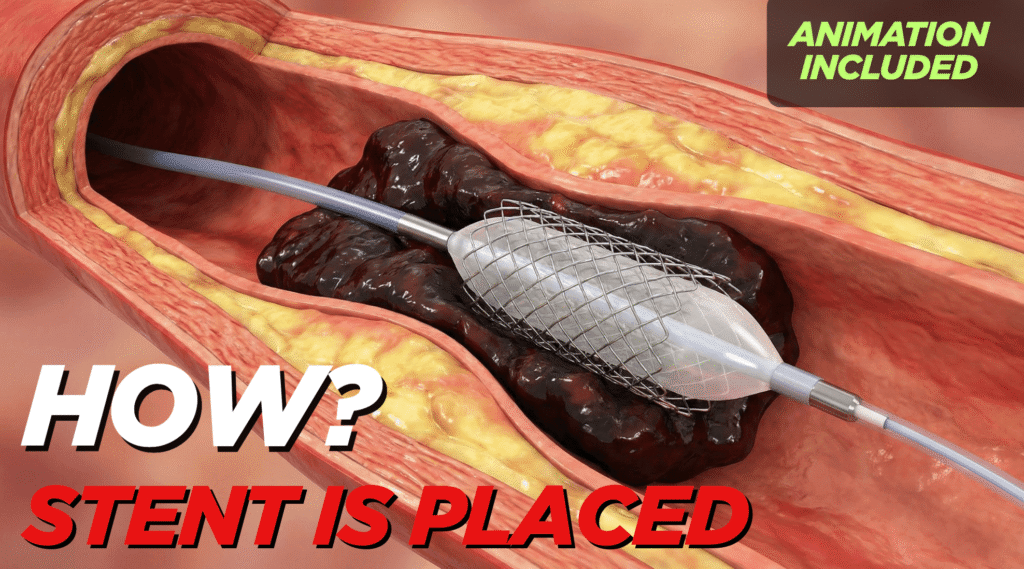
How Stent Is Placed in a Heart Attack
Summarize this blog post with: ChatGPT | Perplexity | Claude | Grok
You’ve probably heard that doctors can save someone from a heart attack in minutes using a tiny metal stent. But what actually happens inside your body during that life-saving procedure? In this guide, you’ll see exactly how a stent is placed step by step—and how it restores blood flow before permanent damage occurs.
Key Takeaways
- Heart stent definition: A heart stent is a small mesh tube inserted into a blocked coronary artery to keep it open and restore blood flow.
- Emergency treatment: Stent placement during a heart attack is performed using coronary angioplasty, a minimally invasive procedure.
- Step-by-step process: Doctors insert a catheter, locate the blockage, inflate a balloon, and deploy the stent.
- Time is critical: Rapid restoration of blood flow reduces heart muscle damage and improves survival rates.
- Types of stents: Drug-eluting and bare-metal stents are the two main types used in cardiology.
- Recovery matters: After the procedure, medications and lifestyle changes are essential to prevent future blockages.
- Early action saves lives: Recognizing symptoms and seeking immediate care is the most important factor in survival.
What Is a Heart Stent and How Does It Work?
A heart stent is a small mesh tube inserted into a blocked coronary artery to keep it open and restore blood flow.
First, a stent acts like a scaffold inside your artery, preventing it from collapsing after a blockage is cleared. For example, imagine a clogged pipe that gets cleaned but collapses again—without support, blood flow would stop again.
Second, most modern stents are drug-coated, meaning they slowly release medication to prevent re-blockage. For example, drug-eluting stents reduce restenosis rates to below 10% — Source: American Heart Association, 2023.
Third, the stent stays in your body permanently and becomes part of the artery wall over time. This process ensures long-term blood flow stability.
For deeper understanding, read our guide on [Internal link: “types of stents used in cardiology” → stent types article].
Why Is a Stent Needed During a Heart Attack?
A stent is needed during a heart attack because a blocked coronary artery stops oxygen supply to the heart muscle.
First, heart attacks occur when a blood clot blocks an artery supplying the heart. For example, plaque rupture triggers clot formation that completely blocks blood flow within minutes.
Second, without oxygen, heart muscle begins to die within 20–30 minutes — Source: National Heart, Lung, and Blood Institute, 2022. This damage can become permanent if not treated quickly.
Third, placing a stent quickly restores blood flow, a process called reperfusion, which dramatically improves survival rates. For example, early angioplasty reduces mortality by up to 30% — Source: European Society of Cardiology, 2023.
To understand the mechanism better, read [Internal link: “how blocked arteries cause heart attacks” → heart attack mechanism article].
What Happens Step by Step During a Stent Procedure?
Stent placement during a heart attack involves guiding a catheter to the blocked artery and expanding a balloon to deploy the stent.
Step 1: Patient Arrival and Diagnosis
First, doctors confirm a heart attack using ECG and blood tests. For example, elevated troponin levels indicate heart muscle damage.
Second, patients are rushed for coronary angiography, which visualizes blockages in real time. Learn more in [Internal link: “coronary angiography explained” → angiography blog].
Step 2: Catheter Insertion
Next, a thin tube called a catheter is inserted through the radial (wrist) or femoral (groin) artery.
For example, the wrist approach is now used in over 70% of cases due to faster recovery — Source: Journal of the American College of Cardiology, 2023.
Step 3: Guiding the Catheter to the Heart
Then, doctors guide the catheter through blood vessels using fluoroscopy (live X-ray imaging).
For example, contrast dye highlights arteries so the blockage becomes clearly visible on screen.
Step 4: Locating the Blockage
Next, contrast dye is injected to identify the exact blockage.
For example, doctors can see narrowed segments where blood flow is reduced or stopped completely.
Step 5: Balloon Angioplasty
Then, a tiny balloon at the catheter tip is inflated at the blockage site.
For example, this balloon compresses plaque against artery walls, reopening the vessel.
Step 6: Stent Deployment
Next, the stent mounted on the balloon expands and locks into place.
For example, once expanded, the stent remains permanently in the artery to keep it open.
Step 7: Blood Flow Restoration
Finally, blood flow is restored instantly, often relieving chest pain within minutes.
Rapid restoration of blood flow reduces heart muscle damage and improves survival rates in heart attack patients.
How Long Does It Take to Place a Stent in an Emergency?
A stent procedure during a heart attack typically takes 30 to 90 minutes from start to finish.
First, hospitals aim for a door-to-balloon time under 90 minutes, which is the global standard. For example, faster treatment significantly improves survival rates.
Second, experienced teams can perform the procedure even faster in critical cases.
What Are the Different Types of Heart Stents?
The two main types of heart stents are drug-eluting stents and bare-metal stents.
| Feature | Drug-Eluting Stent | Bare-Metal Stent |
| Coating | Medication-coated | No coating |
| Restenosis Risk | Low | Higher |
| Use Case | Most patients | High bleeding risk patients |
| Cost | Higher | Lower |
First, drug-eluting stents release medication that helps prevent the artery from becoming blocked again.
Second, bare-metal stents are used when long-term medication is not suitable.
For detailed comparison, see [https://youtu.be/etNDOC-JYJg].
What Happens Immediately After a Stent Is Placed?
After a stent is placed, patients are monitored and given medications to prevent clot formation.
First, patients stay in the hospital for observation, usually 1–3 days.
Second, doctors prescribe dual antiplatelet therapy (DAPT), such as aspirin and clopidogrel.
For example, stopping these medications early can cause stent thrombosis, which is life-threatening.
Third, recovery begins immediately with gradual return to normal activity.
For full recovery guidance, read [“post heart attack recovery plan” → recovery guide].
What Are the Risks of Angioplasty and Stent Placement?
Stent placement is generally safe but carries risks such as bleeding, clotting, and restenosis.
First, bleeding at the catheter site is the most common complication.
Second, restenosis (re-narrowing) occurs in a small percentage of patients, especially without drug-eluting stents.
Third, stent thrombosis, though rare, can cause another heart attack.
For example, proper medication reduces this risk to less than 1% — Source: American College of Cardiology, 2023.
How Successful Is Stent Placement in Heart Attack Patients?
Stent placement during a heart attack has a success rate exceeding 95% in restoring blood flow.
First, success depends on how quickly treatment begins.
Second, early intervention reduces complications and improves long-term survival.
For example, patients treated within the first hour have significantly better outcomes — Source: WHO, 2022.
Tools and Technology Used in Stent Procedures
Stent placement relies on advanced imaging and precision tools to safely restore blood flow.
First, angiography provides real-time visualization of arteries.
Second, catheters act as delivery systems for balloons and stents.
Third, fluoroscopy guides the procedure with continuous imaging.
For deeper insights, explore [“how medical imaging works in cardiology” → imaging guide].
[Insert image: Angiography screen showing blocked artery | Alt text: “Visualize blocked coronary artery during angiography procedure”]
[Insert image: Balloon angioplasty and stent placement diagram | Alt text: “Explain how stent is placed in a heart attack step by step”]
What Should You Do Next If You Suspect a Heart Attack?
Recognizing symptoms early and seeking immediate medical care is the most important step in surviving a heart attack.
First, watch for symptoms like chest pain, shortness of breath, and sweating.
Second, call emergency services immediately instead of driving yourself.
Third, follow medical advice strictly after treatment.
For symptom awareness, read [Internal link: “early signs of a heart attack” → symptom guide].
Also, focus on prevention through [“lifestyle changes to prevent heart disease” → prevention article].
Conclusion
A heart stent is one of the most powerful life-saving tools in modern medicine, restoring blood flow within minutes during a heart attack.
Ultimately, understanding how this procedure works can reduce fear and help you act quickly in emergencies. By recognizing symptoms early and seeking immediate care, you give yourself or your loved ones the best chance of survival.
Written by KABS Kariyapperuma, BPharm (Hons), MSc Applied Organic Chemistry in medical education and pharmaceutical sciences
Reviewed by Medical Content Review Team in cardiology and clinical procedures
Disclaimer: This article was initially drafted using AI assistance. However, the content has undergone thorough revisions, editing, and fact-checking by human editors and subject matter experts to ensure accuracy.